
Prepare for your certification with PSSR Mock Test Set 6 (2026), specially created for seafarers who want to strengthen their knowledge before appearing for the exit examination. This practice set covers important topics commonly asked in the latest assessments.
The Personal Safety and Social Responsibilities (PSSR) course is a mandatory STCW basic safety training program. It teaches safe working practices, emergency procedures, teamwork, pollution awareness, and responsible conduct while working onboard a ship.
This 2026 PSSR Mock Test contains 30 carefully selected multiple-choice questions based on the latest training syllabus and maritime safety standards. Regular practice helps improve confidence, identify weak areas, and increase your chances of passing the exam successfully.
Start solving PSSR Set 6 Questions and Answers – 2026 today and take the next step toward becoming a safer and more competent maritime professional.
SET - 6 | PSSR Exit Exam Mock Test - Questions and Answers - 2026
MARINE EXAM
15 min read
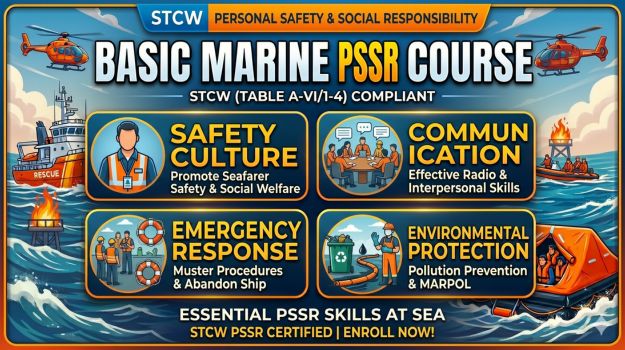
Practice with 30 questions from the BASIC PSSR COURSE bank. Each question is verified and explained.
MCQ Practice Questions (30)
Live Mock Test
Question 1 / 30
Time Left: 15:00
Loading question...
🎉 Mock Test Complete
Your Examination Result
0 / 30
Score Percentage: 0%
Correct
0
Incorrect
0
Skipped
0
1
According to MARPOL Annex V, which type of garbage is strictly prohibited from being discharged into the sea from a ship, regardless of distance from land?
a
Food waste that has been comminuted or ground, more than 3 nautical miles from land.
b
Clean ballast water.
c
All plastics, including synthetic ropes and fishing gear.
d
Deck wash water containing no detergents or chemicals.
Correct Answer: Option C
MARPOL Annex V prohibits the discharge of all plastics into the sea, which includes but is not limited to plastic bags, synthetic ropes, fishing gear, and plastic items.
2
Crew Competency means
a
Proper maintenance of equipment
b
Proper hygienic conditions maintained
c
Well trained personnel with proper certification
d
Medical fitness certification
Correct Answer: Option C
Crew competency, as defined by international maritime conventions such as STCW, directly refers to well-trained personnel possessing the necessary knowledge, understanding, and proficiency, validated through proper certification. This ensures seafarers have demonstrated the required standards for their assigned duties, contributing fundamentally to safe ship operation and pollution prevention.
3
What kind of safety signs needs to be placed in connection with work in radar masts ?
a
A sign on all doors to the bridge
b
No particular sign
c
A sign in the engine control room
d
A fixed signs on each radar when work is in progress in the mast
Correct Answer: Option D
When work is conducted in radar masts, there is a serious risk of injury from electromagnetic radiation should the radar units be inadvertently activated. Placing a fixed warning sign directly on the control panel or switch of each radar unit clearly indicates that personnel are aloft and prohibits the energizing of the equipment, thereby preventing accidental activation and safeguarding the lives of those working in the mast. This critical safety measure aligns with general maritime safety regulations, including lockout/tagout procedures and safe working practices for hazardous energy sources.
4
Which of the following is correct, which is used to log all important radio communications onboard?
a
Garbage record book
b
Deck log book
c
Engine log book
d
GMDSS log book
Correct Answer: Option D
The GMDSS log book is the specifically designated and legally required record for logging all vital radio communications, including distress, urgency, and safety traffic, as mandated by SOLAS Chapter IV. This dedicated log systematically documents all operational events, equipment tests, and battery conditions related to the vessel's Global Maritime Distress and Safety System, ensuring a comprehensive and auditable record crucial for maritime safety and regulatory compliance.
5
A Suez Max Cruds Carrier is ideally terminal to be of the size
a
80,000 - 119,000 DWT
b
2,00,000 - 3,19,999 DWT
c
1,20,000 - 199,999 DWT
d
55,000 -79,000 DWT
Correct Answer: Option C
A Suezmax crude carrier's optimal size range for transiting the Suez Canal is between 120,000 and 199,999 DWT, as vessels larger than this limit face restrictions or cannot pass through the canal. This capacity ensures efficient and safe passage for crude oil transportation, adhering to international maritime trade and canal transit regulations. Therefore, Option C accurately defines the ideal size for a Suezmax crude carrier in terms of terminal compatibility and operational feasibility.
6
Upon discovering a small fire on board a vessel, what should be your immediate action after raising the alarm?
a
Go directly to your muster station.
b
Attempt to extinguish it using available equipment, if safe to do so.
c
Wait for the designated fire team to arrive.
d
Collect your personal belongings and prepare to abandon ship.
Correct Answer: Option B
After raising the alarm, crew members should attempt to extinguish a small fire if it is safe, without endangering themselves, to prevent escalation.
7
Which of the following items is NOT typically considered essential Personal Protective Equipment (PPE) required for routine deck operations on a vessel?
a
Safety helmet
b
Safety shoes
c
Hearing protection
d
Sunscreen lotion
Correct Answer: Option D
While sunscreen is beneficial for health, safety helmets, shoes, and hearing protection are essential PPE to protect against physical hazards during routine deck work.
8
Your vessel is equipped with totally enclosed lifeboats. Which statement is True when the boat is enveloped in flames?
a
The motor takes its air supply from outside the lifeboat to prevent asphyxiation of the crew
b
An air tank will provide about ten mins of air for the survivors and the engines
c
The ventilators will automatically close by the action of fusible links
d
A water spray system to cool the outside of the boat is operated by high volumn manual pumb
Correct Answer: Option B
A totally enclosed lifeboat designed for fire protection relies on a self-contained compressed air system when enveloped in flames. This system maintains a positive internal pressure, supplying vital breathable air for the occupants and clean combustion air for the engine, thereby preventing the ingress of smoke and toxic gases. SOLAS LSA Code mandates this air supply must be sufficient to ensure safe operation for a minimum of 10 minutes in such hazardous fire conditions.
9
Upon hearing the general emergency alarm (seven short blasts followed by one long blast), what is the immediate and correct action required by all crew and passengers?
a
Immediately proceed to the nearest lifeboat station.
b
Contact the bridge for specific instructions.
c
Go to your cabin to retrieve personal belongings and documents.
d
Proceed to your assigned muster station according to the Muster List.
Correct Answer: Option D
The general emergency alarm signals a serious incident, and all personnel must immediately proceed to their assigned muster station as detailed in the ship's Muster List.
10
Upon hearing the general emergency alarm (seven short blasts followed by one long blast), what is the immediate action a crew member should take?
a
Proceed to the nearest lifeboat station immediately.
b
Head to their cabin to collect personal belongings.
c
Muster at their assigned emergency station, taking their lifejacket if instructed.
d
Wait for further instructions via the public address system before taking any action.
Correct Answer: Option C
The general emergency alarm signals the need to proceed promptly to your assigned muster station, bringing a lifejacket if directed or it's an abandon ship scenario.
11
According to MARPOL Annex V, which of the following actions is strictly prohibited regarding garbage disposal from a vessel?
a
Disposing of food waste into the sea outside special areas, more than 12 nautical miles from shore.
b
Incinerating plastics on board if the incinerator is approved.
c
Discharging plastics into the sea under any circumstances.
d
Grinding glass and metal before discharging it into the sea more than 12 nautical miles from shore.
Correct Answer: Option C
MARPOL Annex V prohibits the discharge of all plastics into the sea, regardless of distance from shore or whether it's a special area.
12
Confirm that all gas tight doors and access hatches are kept open before sailing and make sure they are kept open through out the voyage
a
False
b
True
Correct Answer: Option A
Gas-tight doors and access hatches are critical watertight integrity components, and their closure is essential for maintaining the watertight subdivision of the vessel, particularly during a voyage as per SOLAS regulations. Keeping them open compromises the vessel's ability to withstand flooding and maintain stability in adverse conditions, posing a severe safety risk. Therefore, the statement is false; these doors and hatches must be securely closed and sealed unless specifically required for operational purposes and then only under strict supervision.
13
Responsible for any fine incurred to vessel because of him on drug abuse
a
Crew member
b
Company
c
P$I club
d
RPSL Company
Correct Answer: Option A
Under international maritime law, specifically adhering to principles of the Maritime Labour Convention and STCW, individuals are directly accountable for their actions, including those arising from drug abuse, which can result in financial penalties for the vessel. Therefore, the crew member responsible for the drug abuse is the one held accountable for any fines incurred. The company, P&I Club, or RPSL are not directly liable for the personal misconduct of an individual crew member.
14
The contingency plans should identify various types of emergencies which may arise on a particular ship and may Include ___
a
Allocation of duties and Responsibilities
b
Action to be taken to regain control of situation
c
Communication methods within and outside ship
d
All the above
Correct Answer: Option D
Contingency plans, as mandated by SOLAS and reflecting best maritime safety practices, must comprehensively address all potential emergencies, which inherently involves clearly defining the allocation of duties and responsibilities, outlining specific actions to regain control, and establishing robust communication protocols both internally and externally. Therefore, Option D, "All the above," correctly encompasses these essential elements for effective emergency preparedness.
15
Which sea area is marked as special area for pollution_____________
a
Arabian sea
b
Bay of Bengal
c
North sea
d
None of the above
Correct Answer: Option C
The North Sea is designated as a special area for pollution under MARPOL Annex I and Annex V, requiring stricter regulations for the discharge of oil and garbage to protect its sensitive marine environment. This designation mandates specific measures for waste management and oil pollution prevention for ships operating within this region. Therefore, Option C is correct based on international maritime pollution conventions.
16
What is the most likely cause of suffocation?
a
Electrical Equipment
b
Fall
c
Sharp objects
d
Lack of oxygen
Correct Answer: Option D
Suffocation, as defined by maritime safety standards, directly results from the absence of sufficient oxygen in the immediate environment, leading to asphyxiation. While other hazards might indirectly contribute to a compromised atmosphere, the fundamental physiological cause of suffocation is a lack of breathable air, which is a critical concern addressed in emergency procedures and safety training under SOLAS and STCW. Therefore, the most direct and accurate cause of suffocation is a deficiency in oxygen.
17
As per STCW 2010, what is the validity of Medical certificate of crew members?
a
1 year
b
2 years
c
3 years
d
4 years
Correct Answer: Option B
As per STCW 2010 Regulation I/9 and Section A-I/9, the maximum period of validity for a seafarer's medical certificate is two years. This requirement ensures the continuous assessment of a seafarer's fitness for duty, directly contributing to the highest standards of maritime safety by ensuring all crew are medically fit to perform their duties at sea.
18
What is the first action to be taken when you encounter an emergency situations
a
Muster the crew in the designated area
b
Sound the Emegency Alarm
c
Try to fight the emergency on your own
d
Wait for further instructions
Correct Answer: Option B
Sounding the emergency alarm is the absolutely critical first action when encountering any emergency, as it immediately notifies all personnel onboard of a dangerous situation. This fundamental requirement, enshrined in international maritime safety standards like SOLAS and STCW, ensures prompt initiation of the vessel's emergency response plan and facilitates a coordinated effort to mitigate the threat. Delaying this vital notification jeopardizes the safety of the vessel and crew.
19
Which of the following is considered an essential piece of Personal Protective Equipment (PPE) when working in an engine room or cargo hold, primarily to protect against falling objects or accidental impacts?
a
Safety spectacles
b
Hearing protection
c
Hard hat
d
High-visibility vest
Correct Answer: Option C
A hard hat is specifically designed to provide protection against head injuries from falling objects or impacts, which is a significant risk in areas like engine rooms or cargo holds.
20
_______________shall be launched and operated on the water on at least once in three months
a
Every rescue boat
b
Every life raft
c
Every life boat
d
Both life boat and rescue boat
Correct Answer: Option D
According to SOLAS Chapter III, Regulation 20, both every lifeboat and every rescue boat are required to be launched and operated on the water at least once in every three months to ensure their operational readiness and the proficiency of the crew. This regular testing is crucial for effective emergency response, confirming the functionality of launching appliances and the boats themselves, as well as familiarizing personnel with their deployment procedures. Therefore, Option D accurately reflects these mandatory requirements for both lifeboats and rescue boats.
21
A limit of______________% on the Sulphur content of marine fuel oil will apply designated Sox Emission control area
a
5%
b
50%
c
0.5%
d
10%
Correct Answer: Option C
The International Maritime Organization (IMO) mandates a maximum Sulphur content of 0.5% for marine fuels within designated Sulphur Oxide (SOx) Emission Control Areas (SECAs), as stipulated by MARPOL Annex VI. This stringent limit is crucial for reducing harmful SOx emissions and protecting air quality and human health. Therefore, 0.5% is the correct regulatory threshold for fuel oil Sulphur content in SECAs.
22
Why is understanding the shipboard hierarchy and communication channels crucial for a new seafarer?
a
To determine their future salary increases and promotions.
b
To know whom to report to, how to convey information effectively, and where to seek guidance.
c
To avoid performing certain duties they find undesirable.
d
To prioritize social interactions over work tasks during leisure time.
Correct Answer: Option B
A clear understanding of the shipboard hierarchy and communication protocols ensures efficient operations, proper reporting of issues, and effective emergency response.
23
What is the immediate action required upon hearing the general alarm signal (seven short blasts followed by one long blast) on a vessel?
a
Proceed directly to the nearest lifeboat station without your lifejacket.
b
Report to your assigned muster station, ensuring you have donned your lifejacket.
c
Immediately don your immersion suit and await further instructions in your cabin.
d
Wait for an announcement from the bridge before taking any action.
Correct Answer: Option B
The general alarm indicates an emergency; you must report to your assigned muster station with your lifejacket, as per ship's emergency instructions and IMO regulations.
24
Which is most likely cause of particle in eye
a
Flying dust
b
Fall
c
Sharp objects
d
Lack of oxygen
Correct Answer: Option A
Flying dust is the most probable cause of a particle entering the eye in a marine environment due to its prevalence during cargo operations, maintenance activities, or strong winds on deck. This highlights the critical importance of mandatory eye protection, such as safety glasses or goggles, as stipulated by company safety management systems and STCW personal safety training requirements to mitigate such preventable injuries.
25
At sea, if some one fell overboard and you did not know over which side the person fell, you should
a
Donot stop the propellors and throw a lifebuoy
b
Jump into the water and search for the person
c
Do nothing
d
Stop the propellors from turning and throw a life Buoy over the side
Correct Answer: Option D
The correct action is to immediately stop the propellers to prevent injury to the overboard person and deploy a lifebuoy on the nearest side to mark the location and aid their buoyancy. This procedure aligns with SOLAS and STCW requirements for man overboard situations, prioritizing the rescue of the casualty and the safety of the vessel's machinery. Promptly stopping the engines is crucial as rotating propellers present an immediate and severe hazard to anyone in the water.
26
When charging a 100 amp-hour lead-acid battery, __________.
a
the temperature of
the electrolyte should
not be allowed to
exceed 90° F
b
the charging rate
should be no greater
than 125% of the
battery amp-hour
rating
c
the source of power
for charging should
be 2.5 volts per cell
d
gassing within the
battery decreases
when nearing full
charge and it will be
necessary to reduce
the charging current
to a low finishing rate
Correct Answer: Option C
When charging a 100 amp-hour lead-acid battery, the charging source should provide approximately 2.5 volts per cell, ensuring a sufficient voltage difference for effective charging while minimizing the risk of overcharging and damage. This voltage setting is critical for maintaining battery health and longevity, adhering to established marine engineering standards for safe and efficient battery operation. Overcharging can lead to excessive gassing and thermal runaway, jeopardizing safety and equipment integrity.
27
What is the primary purpose of wearing Personal Protective Equipment (PPE) on board a vessel?
a
To look professional during work hours.
b
To comply with casual dress code standards.
c
To protect oneself from identified workplace hazards.
d
To make difficult tasks easier to perform.
Correct Answer: Option C
PPE is essential for minimizing exposure to workplace hazards that can cause serious injuries or illnesses, ensuring crew safety.
28
Below precautions on entering dangerous spaces not relevant
a
Complete risk assessment must be done after identifying the hazard
b
The atmosphere should be tested
c
Communication is never checked
d
A permit to work system should be used
Correct Answer: Option C
When entering dangerous spaces, robust safety protocols are mandatory, making communication checks a vital prerequisite. Option C states communication is never checked, directly contradicting the fundamental requirement for effective communication and standby arrangements stipulated by SOLAS and STCW to ensure rescue and immediate assistance in case of emergencies. Therefore, the statement that communication is never checked is the incorrect precaution, and thus the correct answer to the question about irrelevant precautions.
29
Disadvantages of written comminication
a
The preparation of written documents is time consuming
b
It is Not time consuming
c
None of these
Correct Answer: Option A
Option A is correct because the comprehensive preparation of written documents, encompassing drafting, review, and formal distribution, inherently requires a significant investment of time. In the demanding maritime environment, where swift decision-making and rapid communication are often critical for immediate operational safety and efficiency as mandated by SOLAS and STCW, this time consumption can be a distinct disadvantage, potentially delaying urgent actions or diverting attention from critical real-time duties.
30
The windlass is located at
a
The stern of the ship
b
The forecastle of the ship
c
Amidships
d
The engine room
Correct Answer: Option B
The windlass is strategically located on the forecastle, the forwardmost part of the main deck, because its primary function is the efficient and safe handling of the anchors and anchor chain. This positioning directly above the hawsepipes ensures optimal mechanical alignment and operational control for heaving up and letting go anchors, which is a fundamental principle of ship design and safe seamanship practices. This placement is critical for compliance with operational safety standards during anchoring maneuvers, reflecting established marine engineering and maritime safety requirements.
About Me

FPAPK
Empowering Seafarers with Excellence
FPAPK is a premier online maritime learning platform operated by a dedicated group of marine professionals. We specialize in providing comprehensive study materials, STCW course guidance, and expert-curated mock tests designed to help seafarers navigate their exit exams and career milestones with confidence.
Mock Test Info
Course Name
BASIC PSSR COURSE
Mock Test
6
Questions
30
Students
1,345
Test Time
15 Minutes
BASIC PSSR COURSE
Mock Test Sets
✓
SET - 1 | PSSR Exit Exam Mock - Questions and Answers - 2026
✓
SET - 2 | PSSR Exit Exam Mock - Questions and Answers - 2026
✓
SET - 3 | PSSR Exit Exam Mock - Questions and Answers - 2026
✓
SET - 4 | PSSR Exit Exam Mock - Questions and Answers - 2026
✓
SET - 5 | PSSR Exit Exam Mock - Questions and Answers - 2026
7
SET - 7 | PSSR Exit Exam Mock Test - Questions and Answers - 2026
▶
SET - 6 | PSSR Exit Exam Mock Test - Questions and Answers - 2026
Open
Back To Home