
Prepare for your certification with PSSR Mock Test Set 7 - 2026, designed for seafarers who want to strengthen their knowledge before appearing for the Personal Safety and Social Responsibilities (PSSR) exit examination. This practice set is based on the latest maritime training standards.
The mock test covers important PSSR topics, including personal safety, emergency procedures, accident prevention, onboard communication, teamwork, and safe working practices. These questions help you revise essential concepts that are commonly asked in the final assessment.
This 2026 PSSR Mock Test contains 30 carefully selected MCQs to help you evaluate your preparation and improve your confidence. Start solving PSSR Set 7 Questions and Answers today to enhance your maritime safety knowledge and perform better in your exit exam.
SET - 7 | PSSR Exit Exam Mock Test - Questions and Answers - 2026
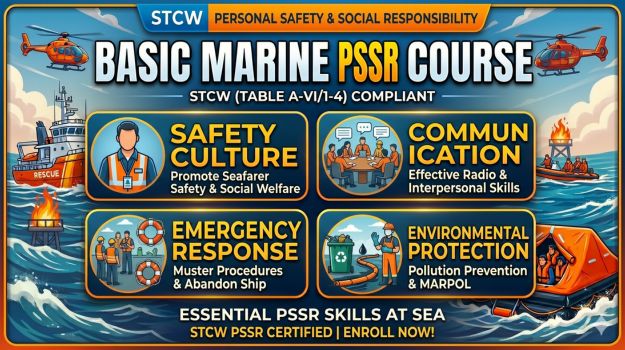
Practice with 30 questions from the BASIC PSSR COURSE bank. Each question is verified and explained.
MCQ Practice Questions (30)
Loading question...
Your Examination Result
You witness a senior officer repeatedly making demeaning remarks and gestures towards a junior crew member, causing visible distress, which is a clear instance of harassment. According to the updated STCW PSSR guidelines (including the 2026 amendments), what is the MOST appropriate course of action you should take?
Reporting through established shipboard channels ensures the incident is formally addressed and investigated, adhering to anti-harassment policies.
Contracts for seafarers while joining ship
Option B is correct because maritime law and international conventions like the Maritime Labour Convention (MLC) 2006, which aligns with SOLAS and STCW principles, mandate that seafarer employment agreements must be in writing and signed by both the seafarer and the shipowner (or their representative) to be legally binding and ensure fair employment conditions. This written contract provides clear terms of employment, wages, repatriation, and other rights, safeguarding both parties and promoting maritime safety and welfare. Verbal agreements lack the necessary clarity and enforceability required for such significant professional contracts.
What does the term 'Safe Working Practices' primarily refer to in the marine environment?
Safe Working Practices encompass all established procedures and precautions designed to protect personnel from harm, ensuring tasks are carried out safely and efficiently without incident.
Advantages of written communication method
Option D is correct because detailed, technical information regarding ship systems, maintenance procedures, and safety protocols, which are critical under SOLAS and STCW, are best conveyed with the precision and visual clarity that written descriptions and diagrams provide, ensuring accurate understanding and execution by mariners. This written record also serves as crucial documentation for compliance and future reference, unlike the transient nature of verbal communication.
A book for maintaing complete records on oil transters within and outside ship
The Oil Record Book is specifically mandated by MARPOL Annex I to meticulously document all operational and accidental discharges of oil, as well as all oil transfers, ensuring compliance with international regulations for preventing marine pollution. This specialized log is the sole official record for tracking oil movement on board and its disposition. Therefore, it is the correct document for maintaining complete records on oil transfers.
Upon discovering a small, contained fire in an accommodation cabin, what is your IMMEDIATE first priority action as per shipboard emergency procedures?
The immediate priority is always to raise the alarm and inform the bridge/OOW to initiate the ship's emergency response, ensuring overall safety before attempting to fight the fire if safe to do so.
Which of the following is considered an essential piece of Personal Protective Equipment (PPE) when working in an engine room or cargo hold, primarily to protect against falling objects or accidental impacts?
A hard hat is specifically designed to provide protection against head injuries from falling objects or impacts, which is a significant risk in areas like engine rooms or cargo holds.
Your vessel is a tanker in ballast and the two vessels are interlocked after collision. You have already made clear that all people are well taken care off and you will try to separate the two vessels. What should be your greatest concern?
Your greatest concern must be the risk of ignition, as attempting to separate two vessels, especially a tanker, after a collision can generate sparks that may ignite flammable cargo or substances, leading to a catastrophic fire or explosion in accordance with SOLAS and IMO guidelines for hazardous cargo operations. This scenario poses the most immediate and severe threat to life and property among the given options. Therefore, any separation maneuver must be executed with extreme caution and the highest safety protocols in place to mitigate this specific risk.
The master may conduct random unannounced alcohol tests at least____________
The master may conduct random unannounced alcohol tests at least monthly, as per common industry practice and guidance often referenced within maritime safety management systems which are designed to comply with SOLAS and STCW regulations on fitness for duty. This frequency balances the need for effective deterrence and early detection of substance abuse with practical operational considerations. Regular, but not overly burdensome, testing helps ensure a safe working environment for all crew members.
The designated SECA(Sox emission control Areas)
SOx Emission Control Areas are designated under MARPOL Annex VI to limit sulfur oxide emissions from ships. Both the North Sea/English Channel and the Baltic Sea are established SECA regions, requiring vessels to comply with stricter fuel sulfur content limits within these zones. Therefore, Option C, encompassing both regions, correctly identifies designated SECA areas.
A book for maintaining complete records on Garbage transforms to ship/shore
The correct answer is B, the Garbage Log, as MARPOL Annex V mandates a Garbage Record Book for ships to record all garbage discharges and disposals, ensuring compliance with international regulations for preventing marine pollution. This logbook serves as the official documentation for all garbage-related transactions between the ship and shore facilities, or when garbage is discharged at sea. Maintaining an accurate Garbage Log is crucial for demonstrating adherence to waste management protocols and environmental protection standards.
MARPOL Annex II Regulations for control of pollution deals with
MARPOL Annex II specifically regulates the control of pollution by noxious liquid substances when transported in bulk. This annex establishes stringent operational requirements, discharge standards, and tank cleaning procedures to prevent and minimize harmful discharges into the marine environment.
The radiotelephone safety message urgently concerned with safety of a person would be prefixed by the word__________
The radiotelephone urgency signal is "Pan-Pan" (pronounced 'pahn-pahn'), which is correctly used to prefix messages concerning the safety of a vessel or, specifically, a person, when there is an urgent situation but not immediate grave and imminent danger requiring immediate assistance. This signal, defined by the ITU Radio Regulations and foundational to GMDSS procedures under SOLAS, effectively communicates a critical safety concern without escalating to a distress situation.
During injury to personal following action to be taken
Option D is correct as managing an onboard injury requires a phased, yet often concurrent, approach as per maritime safety standards. The initial response always involves immediate first aid, a core competency under STCW requirements for all seafarers. Subsequently, for more serious cases, contacting shore-based radio medical assistance and, if critical, arranging helicopter evacuation are essential steps to ensure the best possible outcome, aligning with SOLAS regulations and SAR protocols.
Precautions to prevent oil pollution include but are not limited to
Option D is correct because MARPOL Annex I regulations mandate comprehensive measures for preventing oil pollution. These include strict adherence to cargo operational manuals for loading, carriage, and discharge (Option A), rigorous maintenance and inspection of all oil containment systems (Option B), and continuous, competency-based training for the crew in oil spill response and prevention procedures (Option C), as stipulated by international maritime conventions and safety standards.
You discover a slippery oil spill on a main deck walkway that poses a significant slip hazard. According to PSSR principles, who should you report this safety hazard to first?
Immediate reporting of safety hazards should be directed to the person in charge of your work area, or the Officer of the Watch, who can take immediate action to mitigate the risk.
The vapors given off by heated fuel oil are heavier than air and are
Heated fuel oil releases hydrocarbon vapors that are denser than air, causing them to accumulate in low-lying areas. When these vapors mix with air within their flammable limits, they create an extremely volatile atmosphere that is highly susceptible to ignition, leading to a catastrophic explosion. This fundamental principle underpins critical safety protocols for tank entry, ventilation, and hot work, as mandated by SOLAS and STCW regarding fire prevention and hazardous atmospheres.
What is Muster list?
The Muster List, a mandatory document under SOLAS Chapter III, Regulation 8, precisely outlines the general emergency alarm signal and the specific duties assigned to every person on board for various emergency situations. It details the actions all crew members must take, including their designated muster stations, and clearly specifies the official procedure for giving the order to abandon ship. This critical list ensures an organized and efficient response to safeguard lives in any maritime emergency.
Upon discovering a small, contained fire in an accommodation cabin, what is your immediate and primary action as per PSSR guidelines and shipboard emergency procedures?
The primary action is to raise the alarm and inform the bridge/duty officer to initiate the ship's emergency response plan, ensuring the safety of all personnel and proper coordination before attempting to fight the fire.
According to MARPOL Annex V, which of the following actions is strictly prohibited regarding garbage disposal from a vessel?
MARPOL Annex V prohibits the discharge of all plastics into the sea, regardless of distance from shore or whether it's a special area.
You are on duty and find yourself experiencing significant fatigue, making it difficult to maintain concentration and potentially compromising safe operation. What is the most responsible action to take, considering shipboard safety and fatigue management guidelines?
Reporting fatigue to a superior is a critical safety measure, allowing for appropriate arrangements to be made to ensure ship and personnel safety, aligning with STCW rest hour and fatigue management principles.
Which of the following job onboard requires a hot work permit
Cutting and welding operations on deck constitute hot work, generating extreme heat, sparks, and molten material that present a significant fire hazard in an environment potentially exposed to flammable substances. Consequently, a hot work permit is mandatory under SOLAS Chapter II-2 and all recognized Safety Management Systems to ensure thorough risk assessment, gas freeing, continuous fire watch, and readily available firefighting equipment. This rigorous permit-to-work system is a critical control measure to prevent catastrophic fires or explosions onboard.
Upon hearing the general emergency alarm (seven short blasts followed by one long blast on the ship's whistle and internal alarm system), what is the immediate action required of all personnel?
The general emergency alarm signifies a serious emergency and requires all personnel to proceed without delay to their assigned muster station for roll call and further instructions.
Which is the most frequently abused drug in the entire world?
Alcohol is globally recognized as the most frequently abused psychoactive substance, and its widespread misuse directly compromises maritime safety and operational effectiveness. Its impairing effects contravene STCW fitness for duty standards and undermine the rigorous demands for vigilance, judgment, and physical capability essential for safe navigation and marine engineering operations under SOLAS. Consequently, strict adherence to comprehensive drug and alcohol policies is critical to prevent accidents and ensure the safety of life at sea.
What is the primary purpose of Personal Protective Equipment (PPE) onboard a vessel?
PPE acts as a last line of defense, protecting individuals from risks when other control measures are insufficient to eliminate or reduce hazards.
In lifeboat situations, which of the following visual distress signal is acceptable for daylight use only?
Option C, the orange smoke signal, is the correct answer because it is specifically designed for daylight use by producing a highly visible orange smoke plume. Unlike red flares, rocket parachutes, or red aerial stars which are primarily effective at night or in low visibility, the smoke signal's distinct color and cloud are best observed under bright daylight conditions, maximizing rescue efforts. SOLAS and STCW regulations mandate a combination of visual distress signals suitable for both day and night to ensure maximum visibility to potential rescuers.
According to MARPOL Annex V, which of the following is generally prohibited from being discharged into the marine environment from a ship?
MARPOL Annex V strictly prohibits the discharge of all forms of plastics, including synthetic ropes, fishing gear, and plastic garbage, into the sea, regardless of distance from land.
Before entry into an enclosed space onboard a vessel, which of the following is NOT an essential requirement for safe entry?
While supervision is critical, entry must be supervised by a 'responsible officer' (e.g., OOW, Bosun, 2nd Engineer), not necessarily limited to the Master or Chief Engineer, provided they are authorized.
How many annexes does international convention for prevention of pollution from ships (MARPOL) have?
The International Convention for the Prevention of Pollution from Ships (MARPOL) is structured into exactly six distinct Annexes, each addressing a specific type of marine pollution. These Annexes sequentially cover regulations for the prevention of pollution by oil, noxious liquid substances, harmful substances carried by sea in packaged form, sewage, garbage, and air pollution from ships. Therefore, the correct answer is Six.
Correct use of life saving appliance should be demonstrated to crew as soon as possible, but not later than____________
The correct answer is **Option C: 2 weeks**. STCW Convention Regulation VI/1 requires that the initial familiarization and basic training, which includes the correct use of life-saving appliances, must be completed within the first two weeks of joining a ship to ensure crew competency in emergencies. This ensures immediate readiness and adherence to SOLAS safety standards.

FPAPK
Empowering Seafarers with Excellence
FPAPK is a premier online maritime learning platform operated by a dedicated group of marine professionals. We specialize in providing comprehensive study materials, STCW course guidance, and expert-curated mock tests designed to help seafarers navigate their exit exams and career milestones with confidence.
Mock Test Sets