

fpapk.com Logo

SET - 12 | PST Exit Exam Mock - Questions and Answers - 2026

Author
By FPAPK
Published: May 07, 2026 at 9:29 am
Share:
MARINE EXAM
15 min read
SET - 12 | PST Exit Exam Mock - Questions and Answers - 2026

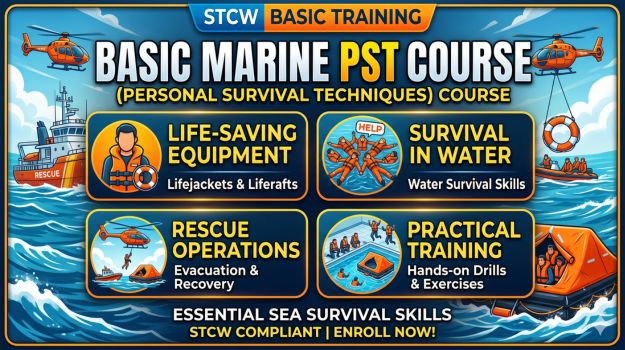
Strengthen your maritime safety expertise with our PST Exit Exam Mock Test (Set-12). This set is designed to test your understanding of high-stakes survival situations as per the 2026 DG Shipping maritime exit exam standards.

What’s covered in Set-12:

  • Thermal Protection: Detailed questions on the use of Thermal Protective Aids (TPA) and how they function to prevent heat loss in extreme cold.

  • Water & Food Management: Understanding the exact storage requirements and the 24-hour waiting period before issuing rations in a survival craft.

  • Lifeboat Occupancy: Rules regarding the maximum number of persons allowed and the distribution of weight for stability.

  • Oil-Covered Water: Special techniques for jumping into and swimming through water that has an oil or fuel spill to avoid ingestion and fire hazards.

Practicing these specialized scenarios ensures you are prepared for the most challenging questions in your certification exam. At FPAPK, we provide the most reliable and up-to-date resources to help seafarers excel in their careers.

Practice with 30 questions from the BASIC PST COURSE bank. Each question is verified and explained.

MCQ Practice Questions (30)

1

A class D fire would involve the burning

a Diesel oil
b Magnesium
c Dunnage
d Electrical insulation
2

Maximum length of a rescue boat

a 2.5 meter
b 3.8 meter
c 5.8 meter
d 8.5 meter
3

What method shall be used when hauling survivors out of the sea (state of survivor critical)

a Using Lifebuoy
b Using Heaving Line
c Using painter line
d Using nets
4

When abandoning ship into a liferaft, what is a critical instruction to follow to minimize injury?

a Always jump head first to ensure a quick entry.
b Jump from the highest possible point to clear the vessel's side.
c Avoid jumping into the water if possible; step into the survival craft if conditions allow, or jump feet-first only when necessary and from a low height, clear of the ship's side.
d Hold onto your personal belongings tightly when jumping.
5

Does CSO required to maintain the records of maintenance/ calibration of security

a True
b False
6

When it is absolutely necessary to jump from a vessel into the water from a significant height, what is the safest body posture to adopt?

a Head first, arms outstretched, to clear obstructions.
b Feet first, legs together, knees slightly bent, arms crossed over the chest, holding nose and mouth.
c Sitting position, legs straight out in front.
d Backwards, arms and legs spread out to create maximum splash.
7

If the ship is on higher security level than the port:

a The ship will lower its security level
b The ship will maintain its security level and sign the DOS
c The ship will call CSO and ask what to do
d The ship will call flag and ask what to do
8

Who can change the ship security level

a The flag state
b The port state
c CSO
d SSO
9

How much faster does the human body lose heat in the water

a 10
b 20
c 26
d 36
10

Which one of the listed requirements regarding rigid life rafts does not correspond to present regulation. The rigid life raft shall be

a A manually controlled lamp visible for 2NM fitted at the top of the canopy
b Floor preventing the ingress of water
c All the entrances fitted with rigid boarding ramps for boarding life raft at sea
d A manually controlled lamp fitted inside the life raft
11

Most enclosed lifeboats will automatically right themselves if they capsize. This will occur when which of the following conditions exists?

a A sea anchor is deployed to windward
b Lower ballast tanks are filled with water
c Fuel tanks are not less than half full
d Passengers are strapped to their seats.
12

Class C fires involve

a Fire involving Gas/Electrical
b Fire involving liquids
c Fire involving solid material
d Fire involving metal
13

The number of lifebuoy on a passenger ship of length above 240 metre

a 14
b 16
c 24
d 36
14

Which shipboard personnel should be able to recognize and detect weapons, dangerous substances and devices.

a SSO
b Master
c Duty officer
d All shipboard Personnel
15

"In what language/languages shall the fire control plans/folders (or copies of plans and folders) be?"

a The English language
b The Flag State language with copies in English or French
c The Flag State language with copies in English
d The Flag State language
16

Which of the following requirements regarding the number of life jackets provided do NOT correspond to present regulations?

a Number of life jackets equal to at least 10% of the total number of passengers and crew to be placed in the vicinity of the muster stations
b A number of lifejackets suitable for children equal to at least 10% of the number of passengers onboard or a greater number as may be required to provide a lifejacket for each child
c A sufficient number of lifejackets for use at remotely located survival craft stations
d A sufficient number of life jackets shall be carried for people on watch
17

What is the primary purpose of the general emergency alarm signal on a ship?

a To call the crew for routine drills.
b To signal that all passengers should go to the nearest lounge.
c To alert all persons on board about an emergency and proceed to muster stations.
d To indicate the ship is arriving at a port.
18

According to the STCW convention and standard emergency procedures, who is primarily responsible for ensuring all persons assigned to their group are accounted for at their designated muster station during an emergency?

a The ship's Master, personally checking everyone.
b The officer on navigational watch.
c Designated heads of departments or appointed muster party leaders.
d The most senior rating at the muster station.
19

fire can be prevented by

a Inspecting electrical appliances for damages
b Not using extension cords
c Smoking only in designated areas
d All of the above
20

When a SAR (Search and Rescue) helicopter lowers a rescue strop or basket to hoist a survivor from the sea, what is the recommended safety procedure for the survivor?

a Grab the equipment as it is still descending, before it touches the water.
b Swim directly underneath the helicopter to stay clear of the equipment.
c Allow the equipment to touch the water or deck first, then wait for a signal or instruction from the helicopter crew before approaching or grasping it.
d Signal the helicopter to move closer by waving both arms vigorously while standing up.
21

The administration may, however ,entrust the verifications to a recognized security organization

a no
b yes
22

Which of the listed requirements do not correspond to the present regulation regarding weak link ? weak links shall

a Be of sufficient strength to permit inflation of the life raft
b Release the life raft at a depth of not more than 4 meters
c Not break by force required to full the painter from the life raft container
d Break under a strain of approximate 2.2 KN
23

Which of the following fire extinguishers is used to put out Class ‘A’ fires?

a CO2
b Water
c Multi – purpose dry chemical
d Both b and c.
24

Who is the first point of contact in office for security related matters for office staff

a The CEO
b THE MD
c The GM
d The CSO
25

A self contained Breathing apparatus should contain at least 1200 Litres of air. How long it should last a normal person when not carrying out hard work?

a 45 Mins
b 30 Mins
c 15 Mins
d 60 Mins
26

How can a person on board a ship familiarise himself with the use of life saving appliances ?

a LSA code
b Maintenance manual
c Training manual
d By roaming around the ship
27

The record is inspected by

a The internal auditor
b The external auditor
c The port state control
d All of the above
28

We shall keep the record for security levels in the last

a 8 ports
b 10 ports
c 12 ports
d 14 ports
29

Life buoy outer diameter should be not more than

a 200 mm
b 400 mm
c 600 mm
d 800 mm
30

What is not included in SSI(likely expansion Ship Security Inspection

a Security program
b Technical details of the screening equipment
c Ships cargo plan
d Location of SSAS
About Me
Avatar

FPAPK

Empowering Seafarers with Excellence

FPAPK is a premier online maritime learning platform operated by a dedicated group of marine professionals. We specialize in providing comprehensive study materials, STCW course guidance, and expert-curated mock tests designed to help seafarers navigate their exit exams and career milestones with confidence.

Mock Test Info
Course Name BASIC PST COURSE
Mock Test 12
Questions 30
Students 1,345
Test Time 15 Minutes
Back To Home