

fpapk.com Logo

SET - 2 | PST Exit Exam Mock - Questions and Answers - 2026

Author
By FPAPK
Published: Apr 29, 2026 at 8:17 am
Share:
MARINE EXAM
15 min read
SET - 2 | PST Exit Exam Mock - Questions and Answers - 2026

Take your preparation to the next level with our PST Exit Exam Mock Test (Set-2). This practice set focuses on advanced survival scenarios and technical knowledge required to pass the DG Shipping exit exams in 2026.

What’s covered in Set-2:

  • Technical specifications of Lifebuoys and Life-jackets.

  • Operating procedures for inflatable life-rafts.

  • Critical actions to take during "Man Overboard" situations.

  • Understanding EPIRB and SART operations for emergency signaling.

By practicing this set, you will gain a deeper understanding of the safety protocols mandatory for all merchant navy professionals. Ensure your success and safety at sea by mastering these essential mock questions.

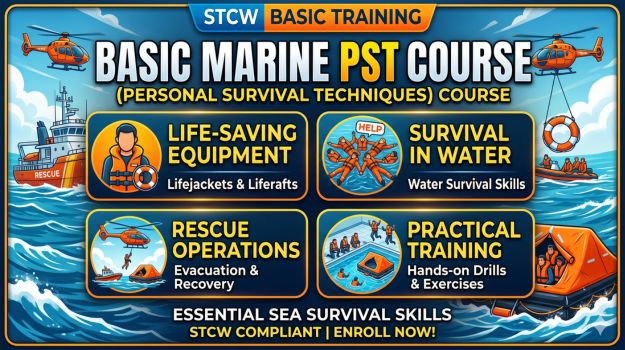
Practice with 30 questions from the BASIC PST COURSE bank. Each question is verified and explained.

MCQ Practice Questions (30)

1

What is the primary function of an immersion suit, as a piece of personal life-saving equipment, in a maritime emergency?

a To provide buoyancy and assist in floating.
b To protect against impact injuries during abandonment.
c To reduce the risk of hypothermia for a person in cold water.
d To make the wearer more visible to rescue services.
2

Upon hearing the abandon ship signal, what is the immediate and most crucial action a seafarer should take according to emergency procedures?

a Proceed immediately to the nearest survival craft and await further instructions.
b Return to the cabin to collect personal belongings before heading to the muster station.
c Proceed to their designated muster station as per the muster list, wearing a life jacket, and await instructions.
d Attempt to contact the bridge for clarification on the emergency.
3

According to STCW requirements, what is the maximum time allowed for a seafarer to don an immersion suit without assistance?

a 1 minute
b 2 minutes
c 5 minutes
d 10 minutes
4

According to STCW and SOLAS regulations, what is the internationally recognized distress signal for 'abandon ship'?

a Seven short blasts followed by one long blast on the ship's whistle and general alarm.
b One long blast followed by seven short blasts on the ship's whistle and general alarm.
c Continuous ringing of the ship's bell for one minute.
d Flashing lights continuously for five minutes.
5

What immediate action should be taken by personnel in a survival craft if they sight a rescue helicopter approaching?

a Ignite a rocket parachute flare immediately to confirm their position.
b Attempt to make contact using the survival craft's VHF radio.
c Prepare to receive the rescue gear, ensuring loose objects are secured and waving slowly to acknowledge.
d Launch a smoke signal directly at the helicopter to attract attention.
6

Which of the following is the primary purpose of a Thermal Protective Aid (TPA) provided in survival craft?

a To provide buoyancy for a person in the water.
b To protect against hypothermia for a person not wearing an immersion suit.
c To signal rescue teams with reflective material.
d To make a person more visible in the water.
7

Which of the following items is an essential signaling device commonly found as part of the standard equipment inside a liferaft, as per SOLAS regulations?

a An automatic rifle.
b A short-wave radio transmitter.
c Hand flares and parachute flares.
d A full set of navigation charts.
8

Which of the following signaling devices is specifically designed to respond to X-band radar signals from searching aircraft or vessels, indicating the position of a survival craft on the radar screen?

a Hand flare
b Smoke signal
c SART (Search and Rescue Transponder)
d Daylight signaling mirror
9

What is the primary danger associated with 'cold water shock' immediately upon entering very cold water?

a Immediate hypothermia.
b Panic, involuntary gasping for breath, and increased heart rate/blood pressure, leading to potential drowning or cardiac arrest.
c Loss of consciousness due to extreme cold.
d Muscle cramps and inability to swim.
10

What is the maximum permissible time for a seafarer to don a life jacket without assistance, according to IMO requirements?

a 60 seconds
b 30 seconds
c 15 seconds
d 90 seconds
11

When launching a davit-launched liferaft, what critical step must be performed before releasing the painter line?

a Ensure all signaling equipment is activated.
b Remove the liferaft's canopy.
c Verify the hydrostatic release unit is disengaged.
d The painter line should only be released once the liferaft is waterborne and all persons are safely inside, to keep it connected to the ship temporarily.
12

When should a red parachute flare be used by survivors in a liferaft or lifeboat?

a At regular intervals during daylight hours to signal general distress.
b Only when land or another vessel is clearly visible on the horizon.
c When a potential search and rescue unit (ship or aircraft) is sighted, to attract immediate attention.
d To illuminate the survival craft at night.
13

What is the recommended method for survivors to maintain body heat and combat hypothermia when grouped together in a survival craft?

a Consistently exercise to generate internal heat.
b Remove wet clothing immediately and expose skin to the air.
c Huddle closely together to share body warmth and reduce exposed surface area.
d Continuously drink cold seawater to cool down internal body temperature.
14

The donning time for immersion suit.

a 2
b 5
c 3
d 1
15

What is the primary function of an immersion suit when abandoning ship in cold water?

a To provide extra buoyancy for swimming.
b To protect against injury from impact with the water.
c To reduce the risk of hypothermia by providing thermal insulation.
d To make the wearer more visible to rescue craft.
16

In accordance with SOLAS requirements, when should an immersion suit typically be worn by a person abandoning a vessel?

a Only if the sea temperature is above 25°C to avoid overheating.
b When the water temperature is below 15°C and survival craft cannot be entered directly from the ship.
c When transferring between two vessels in calm waters.
d During routine deck work in extremely cold weather conditions.
17

When should pyrotechnic distress signals like parachute flares and hand flares be primarily used in a survival situation at sea?

a Continuously from the moment of entering the water.
b Only when land is clearly visible on the horizon.
c When there is a high probability of being seen by a potential rescuer (e.g., aircraft, vessel).
d To celebrate a successful launch of the survival craft.
18

Which of the following is a mandatory item of equipment found in all SOLAS approved survival craft (lifeboats and liferafts)?

a A satellite phone with global coverage.
b Fishing tackle, including hooks, lines, and lures.
c A sea anchor.
d A full medical operating kit, including surgical instruments.
19

Which of the following describes the correct deployment procedure for a 'throw-overboard' type inflatable liferaft?

a It is lowered into the water using a davit system after all personnel have boarded.
b It is thrown overboard, and then the painter line is pulled to inflate it automatically.
c It is inflated on deck and then slid into the water.
d It is released from its securing and floats free, inflating automatically if the ship sinks.
20

Upon hearing the general emergency alarm signal (seven short blasts followed by one long blast), what is the immediate and correct action a seafarer should take according to standard emergency procedures?

a Proceed directly to the nearest lifeboat.
b Await further instructions from the bridge via public address.
c Don a lifejacket and proceed to their assigned muster station as per the muster list.
d Attempt to extinguish any visible fire before mustering.
21

What is the primary function of an Emergency Position-Indicating Radio Beacon (EPIRB) in a maritime distress situation?

a To provide two-way voice communication with rescue services.
b To automatically transmit a distress signal and the vessel's position to satellites for search and rescue coordination.
c To illuminate the area around the survival craft at night.
d To act as a radar reflector for passing ships.
22

What is the primary function of a Search and Rescue Transponder (SART) in a survival craft?

a To send a continuous distress signal via satellite to shore stations.
b To provide two-way voice communication with rescue aircraft.
c To respond with a unique signal when interrogated by a searching radar, indicating the survival craft's position.
d To automatically inflate the survival craft upon activation.
23

During a helicopter hoist rescue, what is the critical safety precaution regarding the grounding wire or static discharge line lowered by the helicopter?

a Immediately grab the grounding wire as soon as it is within reach.
b Allow the grounding wire to touch the water or deck first to dissipate static electricity before touching it.
c Signal the helicopter to retract the grounding wire as it is not needed.
d Use a metallic object to deflect the grounding wire away from yourself.
24

What is the correct procedure immediately after donning a life jacket in an emergency?

a Jump into the water.
b Wait for further instructions without securing it.
c Ensure it is correctly fitted and all straps are securely tightened.
d Remove any personal belongings.
25

According to the STCW convention and standard emergency procedures, who is primarily responsible for ensuring all persons assigned to their group are accounted for at their designated muster station during an emergency?

a The ship's Master, personally checking everyone.
b The officer on navigational watch.
c Designated heads of departments or appointed muster party leaders.
d The most senior rating at the muster station.
26

When it is absolutely necessary to jump from a vessel into the water from a significant height, what is the safest body posture to adopt?

a Head first, arms outstretched, to clear obstructions.
b Feet first, legs together, knees slightly bent, arms crossed over the chest, holding nose and mouth.
c Sitting position, legs straight out in front.
d Backwards, arms and legs spread out to create maximum splash.
27

What is the primary function of an immersion suit, as required for seafarers by the LSA Code and STCW?

a To protect against fire and heat exposure during an emergency.
b To provide thermal insulation and reduce the risk of hypothermia in cold water.
c To assist in signaling rescue services with integrated lights and mirrors.
d To increase visibility for helicopter rescue operations during daylight hours.
28

When abandoning ship into a liferaft, what is a critical instruction to follow to minimize injury?

a Always jump head first to ensure a quick entry.
b Jump from the highest possible point to clear the vessel's side.
c Avoid jumping into the water if possible; step into the survival craft if conditions allow, or jump feet-first only when necessary and from a low height, clear of the ship's side.
d Hold onto your personal belongings tightly when jumping.
29

In a survival craft, if a survivor is showing signs of mild hypothermia, what is the most appropriate immediate action after assessing their condition?

a Encourage them to perform strenuous physical exercise to warm up quickly.
b Offer them an alcoholic drink to warm their body from the inside.
c Provide warm, non-alcoholic, sugary drinks and protect them with additional thermal insulation (e.g., thermal protective aid or blankets).
d Submerge them in hot water to rapidly raise their body temperature.
30

When a SAR (Search and Rescue) helicopter lowers a rescue strop or basket to hoist a survivor from the sea, what is the recommended safety procedure for the survivor?

a Grab the equipment as it is still descending, before it touches the water.
b Swim directly underneath the helicopter to stay clear of the equipment.
c Allow the equipment to touch the water or deck first, then wait for a signal or instruction from the helicopter crew before approaching or grasping it.
d Signal the helicopter to move closer by waving both arms vigorously while standing up.
About Me
Avatar

FPAPK

Empowering Seafarers with Excellence

FPAPK is a premier online maritime learning platform operated by a dedicated group of marine professionals. We specialize in providing comprehensive study materials, STCW course guidance, and expert-curated mock tests designed to help seafarers navigate their exit exams and career milestones with confidence.

Mock Test Info
Course Name BASIC PST COURSE
Mock Test 2
Questions 30
Students 1,346
Test Time 15 Minutes
Back To Home