
Boost your exam preparation with FPFF Mock Test Set 13, designed for seafarers preparing for their final certification assessment. This practice test includes important questions that help you review the key topics covered during the training course.
The Fire Prevention and Fire Fighting (FPFF) course is an essential part of STCW basic safety training. It equips seafarers with the knowledge and practical skills required to prevent fires, operate firefighting equipment, and respond effectively to onboard fire emergencies.
This mock test features 30 carefully selected multiple-choice questions based on the latest maritime training syllabus and exam pattern. Practicing these MCQs regularly can improve your understanding, increase your confidence, and help you perform better in the FPFF Exit Exam 2026.
Start solving FPFF Set 13 Questions and Answers today and take one step closer to successfully completing your maritime fire safety certification.
SET - 13 | FPFF Exit Exam Mock Test - Questions and Answers - 2026
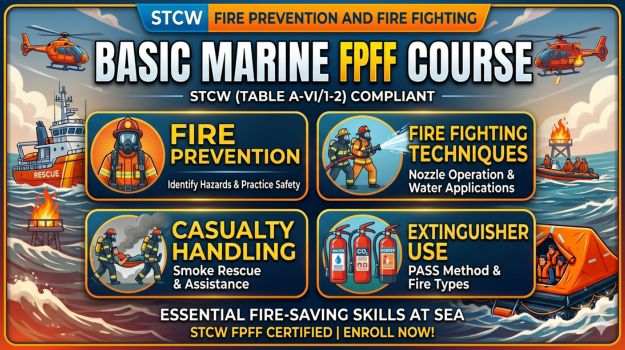
Practice with 30 questions from the BASIC FPFF COURSE bank. Each question is verified and explained.
MCQ Practice Questions (30)
Loading question...
Your Examination Result
Class B fire extinguishers are designed to be used on combustible metals
Class B fire extinguishers are designed for flammable liquids and gases, not combustible metals, which require Class D extinguishers. Class B extinguishers utilize agents like foam, CO2, or dry chemical powder that are ineffective and potentially dangerous on burning metals. This distinction is critical for effective fire suppression and safety aboard vessels, as outlined in maritime safety regulations.
An exit route of three parts : exit access, exit and exit discharge
The statement is true as it correctly defines the fundamental components of an emergency exit route as mandated by international maritime safety regulations, including SOLAS Chapter II-2, which outlines requirements for fire protection, detection, extinction, and evacuation. These three parts ensure a clear and safe path from any location on board to a place of safety outside the vessel. Understanding and maintaining these routes is paramount for effective emergency response and the safeguarding of life at sea.
What fixed firefighting medium do we normally use in the engine room, pump room and other spaces?
The correct answer is A, the CO2 Flooding System, as it is the designated fixed firefighting medium for machinery spaces and pump rooms according to SOLAS regulations, providing a rapid and total flooding capability to extinguish fires by reducing oxygen concentration. Portable extinguishers are supplementary, and while foam may be used in specific situations, CO2 flooding is the primary fixed system for these high-risk areas.
You notice smoke coming from an open laundry room doorway. After activating the fire alarm, which of the following would you do FIRST?
After activating the fire alarm, the immediate priority under STCW basic fire fighting principles is to safely identify the class of fire. This crucial initial assessment, conducted from a safe distance, determines the appropriate extinguishing agent and method, providing vital information to the bridge and fire team for an effective and targeted response to prevent escalation.
What are yearly checks for Dry Chemical powder system on Tankers?
Option B accurately describes critical annual checks for Dry Chemical Powder (DCP) systems on tankers, as required by SOLAS Chapter II-2 and good marine engineering practice. A thorough visual inspection of all system components ensures structural integrity and readiness, while verifying the pressure regulator guarantees correct discharge parameters. Crucially, agitating the dry chemical powder prevents compaction, ensuring it remains free-flowing and effective for immediate fire-fighting capability.
Thermal value is the amount of heat released by a unit mass of fuel
The thermal value, also known as the calorific value, of a fuel is indeed defined as the amount of heat released when a unit mass of that fuel is completely burned. This fundamental property is crucial for engine performance calculations and ensuring safe and efficient combustion within marine propulsion systems, aligning with principles of marine engineering and operational safety standards.
In fire-fighting, what does the term 'boundary starvation' refer to?
Imported via XML Feed
Water fire should be on fires started by which of the following materials?
Water is the primary extinguishing agent for Class A fires, which involve ordinary combustible materials like paper, textiles, wood, and other solid organic substances. Its effectiveness lies in cooling the fuel below its ignition temperature and soaking the material to prevent re-ignition. This application is a fundamental principle of maritime fire fighting, in accordance with SOLAS Chapter II-2 and industry safety standards for fire classification and agent selection.
Before a shipboard fire can be declared completely out, which of the following steps is/are essential?
Declaring a shipboard fire completely out requires a comprehensive assessment to ensure the safety of the vessel and crew, aligning with SOLAS and STCW standards. This encompasses identifying the fire's cause to prevent reoccurrence, confirming the fire area is safe for entry without breathing apparatus, and ensuring it is sufficiently cooled to eliminate re-ignition risks and prevent personnel burns. All these steps are crucial for effective fire control and post-fire safety management.
Combustion generates
Combustion is a rapid chemical process that fundamentally generates **heat** and **light** as primary forms of energy release. Concurrently, it produces **smoke**, especially during incomplete combustion or in actual fire situations on board a vessel. These outputs are critically important for understanding fire safety, engine operation, and are directly addressed in maritime standards such as SOLAS Chapter II-2 and STCW Basic Fire Fighting.
Each fire hydrant is required to have at least one spanner wrench and at least on
SOLAS Chapter II-2, Regulation 10 mandates that each fire hydrant station must be equipped with the necessary appliances for immediate and effective use. This includes at least one spanner wrench for hose connection and a fire hose fitted with an approved dual-purpose or all-purpose nozzle, capable of producing both jet and spray patterns. This ensures the versatility required for effective fire suppression, boundary cooling, and personnel protection in various shipboard fire scenarios, directly supporting maritime safety standards.
Who has the authority to pull the fire alarm after discovering a fire on the worksite
Maritime safety standards, underpinned by SOLAS and STCW, prioritize immediate alarm activation upon discovering a fire to prevent escalation and ensure rapid response. Any person who identifies a fire has the critical responsibility and the authority to activate the fire alarm without delay. This universal duty ensures that all personnel contribute to the earliest possible detection and mitigation of an emergency, which is fundamental to onboard safety.
A dry powder fire extinguisher can be found with a _______________ band above it.
Under the International Convention for the Safety of Life at Sea (SOLAS) and international maritime standards, dry powder fire extinguishers are identified by a blue band above the operating instructions. This color coding is a crucial visual cue to ensure the correct type of extinguisher is selected in emergency situations, aligning with established maritime safety protocols.
Means for forcing water out of a portable extinguisher
A CO2 cartridge is a widely adopted and effective means for expelling water from a portable water fire extinguisher. Upon activation, the compressed CO2 gas is released, pressurizing the water cylinder and forcing the extinguishing agent out through the nozzle with the necessary pressure and reach to combat fires effectively, as required by maritime safety standards for fire-fighting appliances. This design ensures rapid and reliable discharge, critical for emergency response onboard vessels.
"Fuel oil from a leaking fuel pipe has been collected in a drip tray under the boiler furnace. The oil is suddenly ignited by a backflash from the boiler burner. The boiler room is manned and the person present has the choice of various extinguishers. The fire is purely a surface fire. What would be the preferable extinguisher?"
Imported via XML Feed
A self contained Breathing apparatus should contain at least 1200 Litres of air. How long it should last a normal person when not carrying out hard work?
Imported via XML Feed
Radiation is the transfer of heat through the physical movement of particles from hotter to colder zone
Radiation is the transfer of heat through electromagnetic waves, not the physical movement of particles. Heat transfer via particle movement is known as conduction or convection, and these methods are distinct from radiative heat transfer.
Which of the following is true about dry powder fire extinguishers?
Dry powder extinguishers produce a cloud of fine particles which can lead to respiratory issues and reduced visibility, making them unsuitable for confined spaces where such effects are amplified and dangerous. Therefore, it is standard maritime safety practice to avoid their use in enclosed environments.
Portable fire extinguisher is designed to put out______ effectively?
Portable fire extinguishers are specifically designed and certified under SOLAS Chapter II-2 and STCW A-VI/1-2 standards for combating fires at their incipient or initial stages. Their limited agent capacity makes them effective for controlling small, developing fires before they escalate. Attempting to use a portable extinguisher on an explosion, large industrial, or bush fire would be futile and violate fundamental maritime firefighting principles.
What is class of electrical fire?
Electrical fires are specifically designated as Class C fires because they involve energized electrical equipment. This classification is crucial for maritime safety as it dictates the use of non-conductive extinguishing agents, such as CO2 or dry chemical, to effectively suppress the fire without posing an electrical shock hazard to personnel, aligning with STCW fire-fighting principles.
When do you go to the fire assembly point?
Upon activation of the fire alarm, all personnel are required to immediately proceed to their designated fire assembly point, also known as the muster station. This fundamental maritime safety procedure, mandated by SOLAS Chapter II-2 and emphasized in STCW basic safety training, ensures prompt accountability, provides immediate instructions, and facilitates an organized response to the emergency.
Which of the following conditions will allow for a work vest to be substituted for a lifejacket in the total count of the required lifesaving gear?
Work vests are strictly considered personal protective equipment (PPE) designed for buoyancy support during tasks near or over the water, not for emergency abandonment. They lack the specific design features and SOLAS approval required for a lifejacket, which is intended for long-term survival, self-righting, and hypothermia protection in a marine emergency. Therefore, a work vest can never be substituted for or included in the total statutory count of required lifejackets under SOLAS regulations and national maritime safety standards.
Which of the following colours can be found in a band above a wet chemical fire extinguisher?
According to the International Convention for the Safety of Life at Sea (SOLAS), wet chemical fire extinguishers are identified by a yellow band above the main body of the cylinder. This color coding system is crucial for rapid identification of appropriate firefighting equipment in emergency situations, ensuring swift and correct response. Therefore, yellow is the correct color found in a band above a wet chemical fire extinguisher.
Fires resulting from "spontaneous combustion" are usually caused by the improper disposal of _________ .
DG ID: 38FACDE3 | Imported via Chrome Extension
If heat is removed from the fire triangle, what is this called?
Removing heat from a fire is a primary method of extinguishment, known as cooling, which directly targets one of the three essential components of the fire triangle (Heat, Fuel, Oxygen). The act of eliminating any of these elements—be it heat, fuel, or oxygen—is the fundamental principle behind breaking the combustion process and extinguishing a fire. Therefore, "Remove one of the three components of the fire triangle" correctly encapsulates this core fire-fighting strategy as per maritime safety standards and STCW fire prevention training.
During fire, the means of communication
During a fire, effective communication is paramount for crew safety and effective firefighting efforts. SOLAS and STCW regulations mandate that vessels possess multiple, reliable means of communication to ensure that vital information can be relayed, even if certain systems are compromised. Therefore, utilizing messengers, ship's internal telephones, and portable radio-telephone apparatus (walkie-talkies) provides the necessary redundancy and flexibility to maintain communication throughout the emergency.
Oily rags and metal twist pose a particular fire hazard because:
Imported via XML Feed
Which extinguishing agent is recommended in the Chemical Data Guide for use on a carbon disulfide fire?
DG ID: 2DFACDE3 | Imported via Chrome Extension
What is oxygen’s role in making a fire?
As per fundamental principles of fire safety and marine engineering, oxygen is the oxidizing agent in the fire triangle, absolutely essential for the chemical reaction of combustion to occur and continue. Without a constant supply of oxygen, a fire cannot be sustained, leading to extinguishment, hence its critical role in sustaining combustion. Therefore, Option A is correct because oxygen fuels the chemical process that allows the fire to persist.
If discover a fire, what is the most important action to take?
The most critical initial action upon discovering a fire is to raise the alarm, as mandated by SOLAS Chapter II-2 and STCW A-VI/3. This immediate notification ensures the safety of all personnel, mobilizes the ship's entire emergency response organization, and allows the bridge team to initiate crucial containment measures and prepare for external communication. Prompt reporting prevents delayed or uncoordinated responses, which are vital for effective fire management at sea.

FPAPK
Empowering Seafarers with Excellence
FPAPK is a premier online maritime learning platform operated by a dedicated group of marine professionals. We specialize in providing comprehensive study materials, STCW course guidance, and expert-curated mock tests designed to help seafarers navigate their exit exams and career milestones with confidence.
Mock Test Sets