

fpapk.com Logo

SET - 2 | FPFF Exit Exam Mock - Questions and Answers - 2026

Author
By FPAPK
Published: May 23, 2026 at 1:32 pm
Share:
MARINE EXAM
15 min read
SET - 2 | FPFF Exit Exam Mock - Questions and Answers - 2026

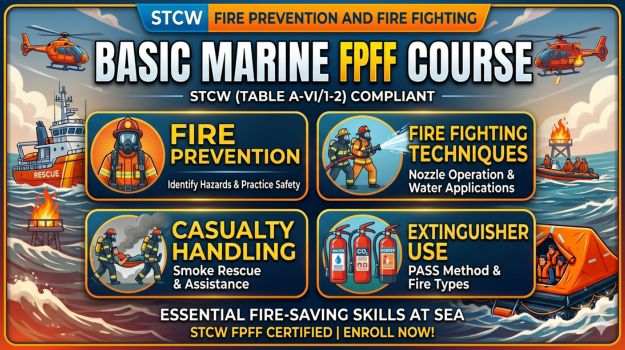
Advance your fire-fighting expertise with our FPFF Exit Exam Mock Test (Set-2). This set focuses on the technical systems and fixed installations used to combat fires on board merchant vessels, aligned with the 2026 DG Shipping exam standards.

What’s covered in Set-2:

  • Fire Detection Systems: Understanding the operation of smoke, heat, and flame detectors.

  • Fixed Fire-Extinguishing Systems: Procedures for using CO2 flooding systems, foam installations, and water mist systems.

  • Fire Hoses and Nozzles: Technical specifications, maintenance, and the correct use of jet and spray (fog) nozzles.

  • International Shore Connection: The purpose and importance of the standard flange for receiving water from shore-based fire services.

By mastering these technical components, you will be better prepared for both the DG Shipping exit exam and the operational challenges of maintaining fire safety at sea. At FPAPK, we provide these curated resources to help you secure your certification and ensure shipboard safety.

Practice with 30 questions from the BASIC FPFF COURSE bank. Each question is verified and explained.

MCQ Practice Questions (30)

1

What type of construction material should be avoided regarding fire protection purposes?

a All uncovered wooden materials
b All composite materials
c All plastic materials
d All combustible materials
2

A disadvantage of using CO2 for fire fighting is that

a They are not effective on Class ‘C’ fires
b They are not effective on Class ‘B’ fires
c The cylinders are pressure regulated vessels
d The CO2 does not cool the fire .
3

Sanitary-, ballast-, bilge- or general service pumps may be accepted as fire pumps provided:

a They can be started from a position outside the engine room
b They are ready for use as fire pumps at any time
c They are not normally used for pumping oil
d They are fitted with automatic start connected to the fire alarm
4

Fuel flowing in a pipe is prone to which of the following ignition sources?

a High pressure action.
b Friction.
c Static electricity.
d Chemical reaction.
5

What is the maximum allowed suction head for the fire pump?

a 4.5 meters.
b 9 meters.
c 1.5 meters.
d 3 meters.
6

"A' class (fire) divisions are those divisions formed by bulkheads and decks. Which of the following requirements does not comply with the rules?"

a Preventing passage of smoke and flame to the end of a one-hour standard test
b Suitably stiffened
c Insulated on both sides with approved non-combustible material
d Constructed of steel or other equivalent material
7

In fire-fighting, what does the term 'boundary starvation' refer to?

a Cooling the area around a fire to stop it spreading
b Closing doors and hatches at the boundary of a fire
c Mustering fire fighters and materials in the area near the fire
d Removing the fuel from the boundary of a fire to stop it spreading further
8

When the whistle sounds whilst using a SCABA set approx 30 minutes of time left for escape

a True
b False
9

What information is found on a ship's fire plan?

a The duties of each crew member in case of fire
b The signal used on the ship to indicate there is a fire.
c The action to take if you heard the fire alarm.
d The locations of various firefighting appliances and equipment.
10

"Where can shore side personnel find necessary information on ship's fire control systems in an emergency situation?"

a From the duty officer.
b A copy of the fire control plan is permanently posted in prominently marked locations onboard ships.
c A copy of the fire control plans/folders is stored in a watertight and prominently marked container outside the deckhouse or accommodation.
d Information is to be given by the owners through the nearest rescue center.
11

Fully pressurized gas carriers are designed for excess pressure in cargo tank above?

a 7 bar
b 8 bar
c 11 bar
d 15 bar
12

Emergency escape routes should be kept

a Open and clear
b Locked at sea
c Locked in port
d Open when needed
13

"Under ISO standard 3941 (used mostly in Europe), a fire involving a flammable solid fuel would be classed as which of the following?"

a Class A.
b Class B.
c Class C.
d Class D.
14

Class D fires involve

a Fire involving metal
b Fire involving liquids
c Fire involving Gas/Electrical
d Fire involving solid material
15

Hazards in galley

a Cooking oil, hot fat
b Hot surfaces, oven, frying pan
c Defective electrical connections
d All of the above
16

Things to remember before opening the door of a fire compartment

a Smoldering of fire
b Flash over/Back draft
c Explosion of flame
d All of the above
17

Which of the following statements is NOT correct about high expansion foam?

a It extinguishes by smothering.
b It has only a limited cooling effect.
c You cannot survive in H.E. foam as the oxygen content is reduced.
d You can survive in H.E. foam by breaking the bubbles to release the air.
18

"If you were put in charge of a fire team what is the minimum number of men wearing BA sets that you would allow to enter a smoke-filled compartment?"

a 2 men
b 1 man
c 4 men
d 3 men
19

Class C fires involve

a Fire involving Gas/Electrical
b Fire involving liquids
c Fire involving solid material
d Fire involving metal
20

"Which firefighting system is the most efficient and with the least side effects in the event of a fire in the engine room?"

a The powder extinguishing system.
b The central foam extinguishing system.
c The sprinkler extinguishing system.
d The central CO2 extinguishing system.
21

What type of fire hose nozzles must be available on board?

a Dual purpose (jet/spray) type incorporating shutoff.
b Jet type.
c Dual purpose (jet/spray type).
d Spray type.
22

Oily rags and metal twist pose a particular fire hazard because:

a They are not a hazard unless ignited.
b They generate their own oxygen when ignited and are therefore difficult to extinguish.
c They are liable to spontaneous combustion.
d They are not a hazard.
23

"In addition to a fire suit, a fireman's outfit also comprises breathing apparatus and a fireproof lifeline. According to SOLAS- how many such sets of fireman's outfit are required to be carried by all ships?"

a At least one.
b At least two.
c As required by the ship's administration.
d At least three.
24

The spread of fire by conduction is when two objects at different temperature are in contact with each other

a True
b False
25

Fires resulting from spontaneous combustion caused by the improper disposal of

a Cigarette buts
b Oily rags
c Burner torches
d None of the above
26

"Three methods of fire protection regarding internal divisional bulk heading may be adopted in accommodation and service spaces in cargo ships. Which of the given methods do not correspond to present rules?"

a Fitting of an automatic sprinkler, fire-detection and alarm system for the detection and extinction of fire in all spaces in which fire might be expected to originate"
b Fitting of a fixed fire-detection and alarm system in all spaces where fire might be expected to originate. No accommodation space bounded by an 'A' or 'B' class division to exceed 500 m
c Construction of all internal bulkheads of non-combustible class 'B' or 'C' divisions
d Construction of all internal bulkheads of class 'A' divisions
27

Fire extinguishers that contain _____ have a red band located above them

a Carbon Dioxide
b Water
c Foam
d Wet Chemicals
28

Dry chemical powder is more suitable to extinguish _____

a Class A type fire
b Class B type of fire
c Class C type of fire
d All of the above
29

"Fuel oil from a leaking fuel pipe has been collected in a drip tray under the boiler furnace. The oil is suddenly ignited by a backflash from the boiler burner. The boiler room is manned and the person present has the choice of various extinguishers. The fire is purely a surface fire. What would be the preferable extinguisher?"

a Powder
b Any of the mentioned alternatives
c CO2
d Water
30

What are class 'C' bulkheads?

a "A. Bulkheads constructed of approved non-combustible materials that can withstand the standard fire test for 30 minutes."
b "B. Bulkheads constructed of approved non-combustible materials that can withstand the standard fire test for 45 minutes."
c "C. Bulkheads constructed of approved non-combustible materials that can withstand the standard fire test for 15 minutes."
d "D. Bulkheads constructed of approved non-combustible materials but do not meet any of the requirements relative to smoke and flame nor limitations relative to temperature rise."
About Me
Avatar

FPAPK

Empowering Seafarers with Excellence

FPAPK is a premier online maritime learning platform operated by a dedicated group of marine professionals. We specialize in providing comprehensive study materials, STCW course guidance, and expert-curated mock tests designed to help seafarers navigate their exit exams and career milestones with confidence.

Mock Test Info
Course Name BASIC FPFF COURSE
Mock Test 2
Questions 30
Students 1,346
Test Time 15 Minutes
Back To Home