

fpapk.com Logo

SET - 6 | FPFF Exit Exam Mock - Questions and Answers - 2026

Author
By FPAPK
Published: May 31, 2026 at 11:17 pm
Share:
MARINE EXAM
15 min read
SET - 6 | FPFF Exit Exam Mock - Questions and Answers - 2026

Master the science of fire detection and suppression with our FPFF Exit Exam Mock Test (Set-6). This set is aligned with the latest 2026 DG Shipping exam standards, focusing on the early warning systems and the physical coordination required to extinguish shipboard fires.

What’s covered in Set-6:

  • Fire Detection Technology: Understanding the difference between Ionization and Photoelectric smoke detectors, and the use of Rate-of-Rise heat detectors.

  • Fire Hose Operations: Best practices for laying out hoses, avoiding kinks, and the importance of the "backup man" in handling high-pressure lines.

  • Nozzle Mastery: When to use a high-velocity jet for deep-seated fires versus a fine water spray for cooling and personnel protection.

  • Fire Main System: Understanding the role of isolation valves and the maintenance of fire hydrants to ensure constant water availability.

By practicing these situational and technical questions, you ensure that you are not only ready for the exit exam but also prepared for real-life emergencies. At FPAPK, we provide the most reliable 2026 mock tests to support your journey in the merchant navy.

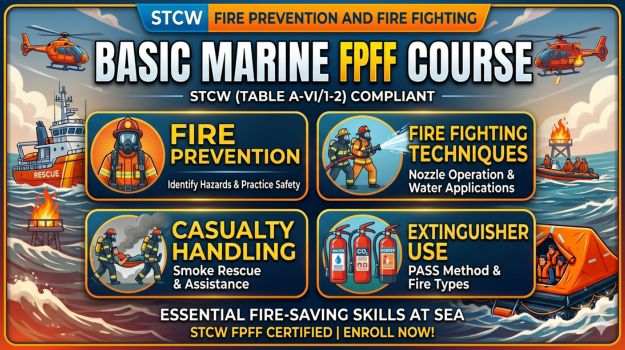
Practice with 30 questions from the BASIC FPFF COURSE bank. Each question is verified and explained.

MCQ Practice Questions (30)

1

What would you use if a pot of hot oil caught fire in gallery?

a A fire hose reel
b A water extinguisher
c A fire blanket
d All of the above.
2

Stairways and corridors used as means of escape shall not be less than 700 mm in clear width

a False
b True
3

"Where will the ship's officers find necessary information regarding the ship's fire protection arrangement, fire-detection equipment and fire extinguishing appliances?"

a In permanently exhibited muster list
b In permanently exhibited fire control plans
c In special instruction and information folder at all fire control stations
d In permanent exhibited alarm instructions
4

Fire extinguishers should be checked at least once a month

a True
b False
5

Hazards in galley

a Cooking oil, hot fat
b Hot surfaces, oven, frying pan
c Defective electrical connections
d All of the above
6

Which of the following types of fire extinguishers have a yellow band above it?

a Foam
b Water
c Wet Chemical
d Carbon Dioxide
7

Which of the following is correct when it comes to the type of fire extinguishers you should avoid while fighting a fire in a confined space?

a Carbon Dioxide and Dry Powder Fire extinguishers should not be used
b Carbon Dioxide and Water Fire Extinguishers should not be used
c Water and Dry Powder Fire extinguishers should not be used
d Only a Dry powder fire extinguisher should not be used
8

Fire is a process of combustion accompanied by the rapid release of heat and ___ in varying intensities

a Light
b Energy
c Destruction
d None of the above
9

Class D fires involve

a Fire involving metal
b Fire involving liquids
c Fire involving Gas/Electrical
d Fire involving solid material
10

Four sides of Fire Tetrahedron are fuel , Heat, Oxygen and

a Hydrogen gas
b Chain Reaction
c Spontaneous combustion
d None of the above.
11

All waste receptacles shall be of non-combustible materials, built and equipped with:

a Hinged self-closing cover
b Permanent means for lashing
c No openings in sides and bottom
d Rack for fire buckets
12

What type of fire hose nozzles must be available on board?

a Dual purpose (jet/spray) type incorporating shutoff.
b Jet type.
c Dual purpose (jet/spray type).
d Spray type.
13

What is class of electrical fire?

a Class A
b Class B
c Class C
d None of the above
14

Portable DCP extinguisher is provided in engine control room

a True
b False
15

International shore coupling is carried on all ships

a True
b False
16

Water fire should be on fires started by which of the following materials?

a Materials such as gasoline that are highly flammable
b Materials made up of combustible metals
c Fires caused by electricity
d Materials such as paper, textiles, wood and other solid materials
17

Before an emergency you should

a Be able to recognize the sound/signal of a fire or evacuation alarm
b Know the procedure in an emergency
c Be aware of the emergency escape to a minimum of 2 exits from
d All the above.
18

Which one is not chemical energy

a Heat of combustion
b Heat of partial oxidation
c Falling tool from a height
d Heat of mixing solution
19

What is oxygen’s role in making a fire?

a It sustains combustion
b It cools down
c It spreads it
d none of these
20

Class A fire division can prevent flame and smoke for the designated time;

a True
b False
21

When you see a fire on the worksite, what is the first thing you should do

a Sound the fire alarm
b Tell you, master
c Try and put the fire out
d Grab your tools and quickly exit the area
22

Which spaces in regard to fire protection, shall be separated from rest of the ship by thermal and structural boundaries?(SOLAS II-2/2.2.2)

a Accommodation
b Cargo compartments
c Storage rooms for inflammable materials
d Machinery spaces
23

Safe practice includes good housekeeping, cleanliness, regular patrolling

a True
b False
24

The fire assembly point can be best described as:

a Where the fire extinguishers are stored
b An area that has a high risk for fires to occur
c An area where you are required to assemble in the event of a fire
d An area you are required to avoid in the event of a fire
25

Fire spreads depends upon on air speed and calorific value of fuel ?

a True
b False
26

Dry chemical powder is more suitable to extinguish _____

a Class A type fire
b Class B type of fire
c Class C type of fire
d All of the above
27

What is kind of fixed fire fighting system that can be used on Main Engine room fire

a High expansion foam
b Medium expansion foam
c Low expansion foam
d All of the above.
28

"In addition to a fire suit, a fireman's outfit also comprises breathing apparatus and a fireproof lifeline. According to SOLAS- how many such sets of fireman's outfit are required to be carried by all ships?"

a At least one.
b At least two.
c As required by the ship's administration.
d At least three.
29

When do you go to the fire assembly point?

a When discussion about fire safety is taking place
b When the fire alarm goes on
c If you are the first one to see the fire
d When practicing using the different types of fire extinguishers
30

Signaling communication through life line-repeated pull

a I m alright
b Give more slack
c Pick up slack
d Pull me out/come out
About Me
Avatar

FPAPK

Empowering Seafarers with Excellence

FPAPK is a premier online maritime learning platform operated by a dedicated group of marine professionals. We specialize in providing comprehensive study materials, STCW course guidance, and expert-curated mock tests designed to help seafarers navigate their exit exams and career milestones with confidence.

Mock Test Info
Course Name BASIC FPFF COURSE
Mock Test 6
Questions 30
Students 1,347
Test Time 15 Minutes
Back To Home