

fpapk.com Logo

SET - 7 | FPFF Exit Exam Mock - Questions and Answers - 2026

Author
By FPAPK
Published: Jun 01, 2026 at 10:30 pm
Share:
MARINE EXAM
15 min read
SET - 7 | FPFF Exit Exam Mock - Questions and Answers - 2026

Strengthen your command over maritime fire safety with our FPFF Exit Exam Mock Test (Set-7). This set is aligned with the latest 2026 DG Shipping exam guidelines, focusing on the chemical chain reactions of fire and the rigorous maintenance standards for shipboard extinguishing equipment.

What’s covered in Set-7:

  • The Fire Tetrahedron: Beyond the triangle—understanding the "Chemical Chain Reaction" and how modern extinguishing agents break it.

  • Fire Extinguisher Servicing: Mandatory weight checks for CO2 cylinders and the frequency of hydraulic pressure testing for portable extinguishers.

  • Cooling vs. Smothering: When to prioritize heat reduction (Water) versus oxygen exclusion (Foam/CO2) based on the fuel source.

  • Fire Watch Duties: The critical responsibility of monitoring a site after a fire has been extinguished to prevent "re-ignition."

Practicing these detailed questions will help you navigate the tricky situational queries in your maritime exit exam. At FPAPK, we provide these curated 2026 resources to ensure you pass your certification and contribute to a safer vessel.

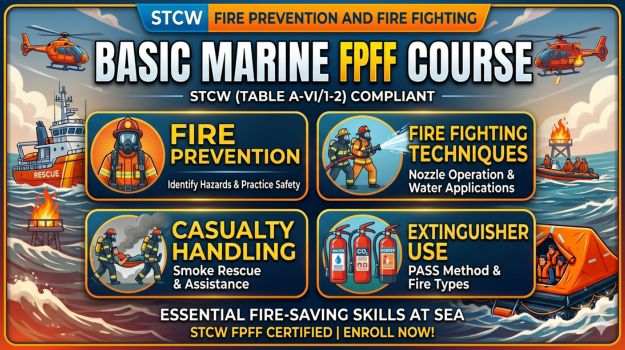
Practice with 30 questions from the BASIC FPFF COURSE bank. Each question is verified and explained.

MCQ Practice Questions (30)

1

Where should you go if you hear the fire alarm going off?

a To the supervisor’s office in order to inform him what is happening
b To the fire assembly point
c To the break room to make sure everyone got out
d Home, the work day is over
2

CO2 alarm visual indication will be a;

a White LED light
b Red revolving light
c Amber coloured revolving light
d Blue light
3

The fire assembly point can be best described as:

a Where the fire extinguishers are stored
b An area that has a high risk for fires to occur
c An area where you are required to assemble in the event of a fire
d An area you are required to avoid in the event of a fire
4

Which one is not chemical energy

a Heat of combustion
b Heat of partial oxidation
c Falling tool from a height
d Heat of mixing solution
5

"In what language/languages shall the fire control plans/folders (or copies of plans and folders) be?"

a The English language
b The Flag State language with copies in English or French
c The Flag State language with copies in English
d The Flag State language
6

Maximum Temperature of unexposed side of a B-class division is?

a 300 Deg C
b 350 Deg C
c 400 Deg C
d 225 Deg C
7

Which of the following conditions will allow for a work vest to be substituted for a lifejacket in the total count of the required lifesaving gear?

a When it is approved by the Coast Guard
b When working near or over the water
c When stowed away from the ring buoys
d Never
8

Which of the following should you NOT do during a fire emergency

a Evacuate through designated exit routes
b Keep the fire doors shut to prevent the fire from spreading
c Crawl low under the smoke while breathing only through your nose
d Abandon ship without the permission of authorities
9

Which of the following fuels has the lowest flash point?

a Candle wax
b Coal
c Kerosene
d Diesel Fuel
10

Which of the following extinguisher is suitable for fire involving flammable liquids

a Carbon dioxide extinguisher (black)
b Powder extinguisher (blue)
c Foam extinguisher (Cream)
d None of these
11

Combustion generates

a Fumes, gases, vapors
b Heat smoke Light
c Sound , rust, dust
d Heat, vibration, smell
12

"If you were put in charge of a fire team what is the minimum number of men wearing BA sets that you would allow to enter a smoke-filled compartment?"

a 2 men
b 1 man
c 4 men
d 3 men
13

The highest concentration of hydrocarbon gas in air below which there is sufficient amount of hydrocarbon gas to support combustion is called.

a Upper Flammable limit
b Lower Flammable limit
c Ignitable mixture
d None of the above
14

Fire extinguishers that contain _____ have a red band located above them

a Carbon Dioxide
b Water
c Foam
d Wet Chemicals
15

In the event of a fire, everyone is responsible for:

a Informing the supervisor of what is happening
b Pulling the fire alarm if they see a fire
c Making sure everyone gets to the fire assembly point safely
d None of the above
16

A disadvantage of using CO2 for fire fighting is that

a They are not effective on Class ‘C’ fires
b They are not effective on Class ‘B’ fires
c The cylinders are pressure regulated vessels
d The CO2 does not cool the fire .
17

Fire is classed into

a 4 types
b 7 types
c 5 types
d 6 types
18

When the whistle sounds whilst using a SCABA set approx 30 minutes of time left for escape

a True
b False
19

Carbon-di-Oxide (CO2) release alarm;

a Similar to general alarm
b Similar to fire alarm
c Distinctive and unique
d Similar to mechanical fault alarm
20

The fire protection provided for the propulsion motor and generator of a diesel electric drive vessel is usually;

a Fixed foam extinguisher
b Fixed CO2 system
c Steam smothering system
d Carbon tetrachloride extinguishing system
21

If there is a black coloured band above the fire extinguisher; what does the colour of the band tell you?

a That this extinguisher is a wet chemical fire extinguisher
b That this extinguisher is a carbon dioxide fire extinguisher
c That this extinguisher is broken and should not be used
d That this extinguisher is broken and should not be used
22

How often should you test your smoke alarms?

a Every month
b Every six months
c Every year
d Every five years
23

International shore coupling is carried on all ships

a True
b False
24

What would you use if a pot of hot oil caught fire in gallery?

a A fire hose reel
b A water extinguisher
c A fire blanket
d All of the above.
25

"Three methods of fire protection regarding internal divisional bulk heading may be adopted in accommodation and service spaces in cargo ships. Which of the given methods do not correspond to present rules?"

a Fitting of an automatic sprinkler, fire-detection and alarm system for the detection and extinction of fire in all spaces in which fire might be expected to originate"
b Fitting of a fixed fire-detection and alarm system in all spaces where fire might be expected to originate. No accommodation space bounded by an 'A' or 'B' class division to exceed 500 m
c Construction of all internal bulkheads of non-combustible class 'B' or 'C' divisions
d Construction of all internal bulkheads of class 'A' divisions
26

Stairways and corridors used as means of escape shall not be less than 700 mm in clear width

a False
b True
27

"Where will the ship's officers find necessary information regarding the ship's fire protection arrangement, fire-detection equipment and fire extinguishing appliances?"

a In permanently exhibited muster list
b In permanently exhibited fire control plans
c In special instruction and information folder at all fire control stations
d In permanent exhibited alarm instructions
28

The area you must assemble in the event of the fire is called :

a The Fire Safety Meeting Spot
b There is no specific name
c The Fire Assembly Point
d The supervisor’s office
29

The spread of fire by conduction is when two objects at different temperature are in contact with each other

a True
b False
30

Carbon- dioxide(CO2) release alarm is fitted outside the engine room?

a True
b False
About Me
Avatar

FPAPK

Empowering Seafarers with Excellence

FPAPK is a premier online maritime learning platform operated by a dedicated group of marine professionals. We specialize in providing comprehensive study materials, STCW course guidance, and expert-curated mock tests designed to help seafarers navigate their exit exams and career milestones with confidence.

Mock Test Info
Course Name BASIC FPFF COURSE
Mock Test 7
Questions 30
Students 1,346
Test Time 15 Minutes
Back To Home